Ask ten Malaysian business owners what "email hosting" is, and most will describe Gmail. That confusion is exactly why so many small businesses still send quotations from [email protected] — and quietly lose credibility with every email they send.
Email hosting is a specific service, separate from free webmail and distinct from (though often bundled with) web hosting. Understanding what it actually is helps you make a smarter, cheaper decision about how your business communicates online.
This guide explains what email hosting is, how it differs from the free and paid alternatives, why it matters more in Malaysia than many owners realise, and how to choose the right option for your business.
What Is Email Hosting?
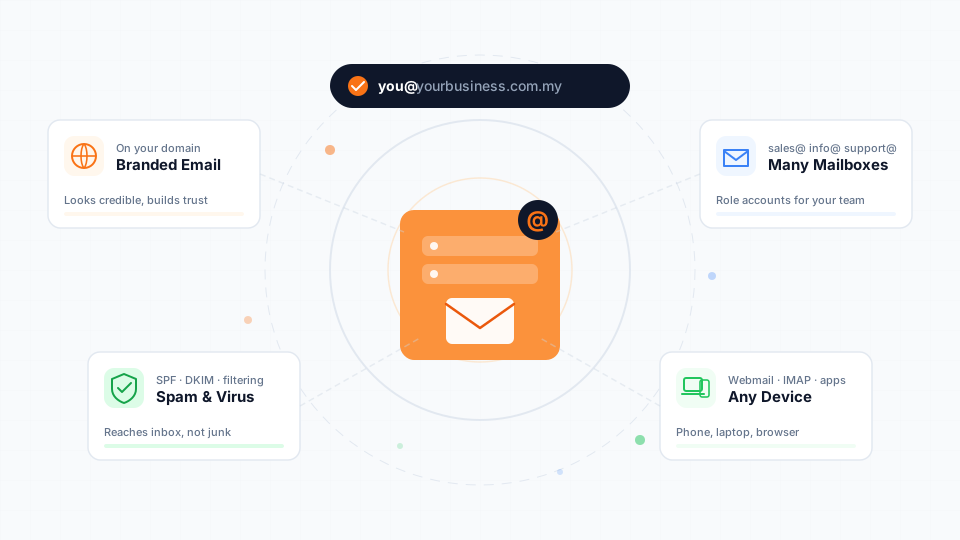
Email hosting is a service that runs your email on a dedicated mail server using your own domain name. Instead of [email protected], you send and receive from [email protected].
The hosting provider operates the mail server, manages storage for your messages, handles the behind-the-scenes delivery between your domain and the rest of the internet, and gives you tools to create and manage mailboxes.
Think of it like the difference between a PO box at the post office and a proper office address:
- Free webmail (Gmail, Yahoo) is the shared PO box — quick, free, but the address belongs to someone else and says nothing about your business.
- Email hosting is your own office address — it carries your brand, you control who has a key, and it signals that you're an established operation.
hello@, sales@, and accounts@ mailboxes, all on the same domain, all managed from one control panel.
Email Hosting vs Free Email vs Web Hosting
These three terms get tangled together constantly. Here's how they actually relate.
Free email
Gmail, Yahoo Mail, and Outlook.com are free, instant, and fine for personal use. The catch is the address: @gmail.com tells customers nothing about your business, you can't create role-based accounts like support@yourbrand, and you have no administrative control if a staff member walks off with the password.
Email hosting
A service built specifically to run email on your domain, with mailboxes, anti-spam filtering, webmail, and the authentication needed to land in inboxes. It can be sold on its own, but for most small businesses it arrives bundled with something they already need: web hosting.
Web hosting (with email included)
Web hosting stores your website. Because the same server can also run a mail service, most hosting plans include email hosting at no extra charge. If you already host a website with a cPanel provider, you almost certainly have email hosting sitting unused. We cover the website side in detail in our guide to what web hosting is.
| Free email | Email hosting | Web hosting + email | |
|---|---|---|---|
| Address | @gmail.com | @yourdomain | @yourdomain |
| Custom domain | No | Yes | Yes |
Role accounts (sales@, info@) | No | Yes | Yes |
| Admin control | No | Yes | Yes |
| Hosts your website too | No | No | Yes |
| Typical cost | Free | Subscription | Included with hosting |
Why Malaysian Businesses Need Email Hosting
Credibility that converts
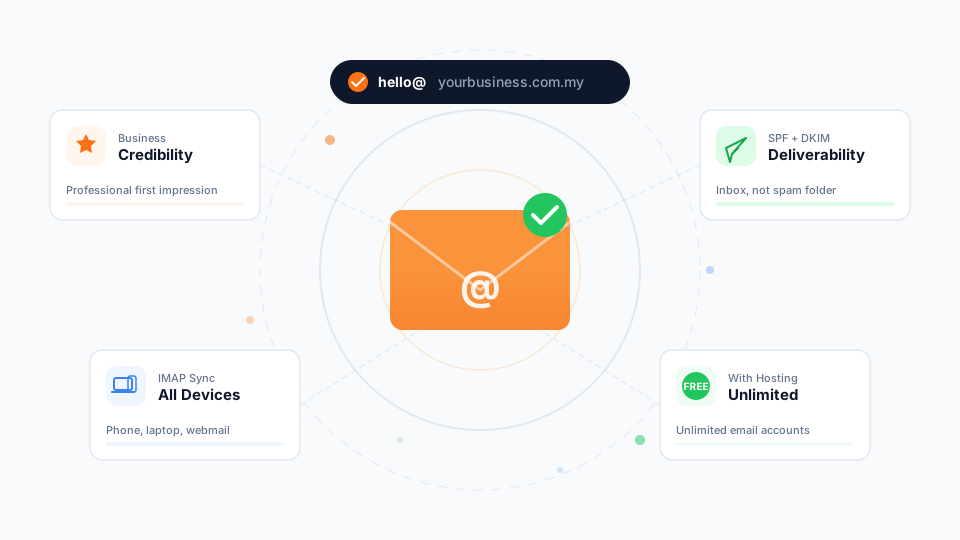
A branded address is a small detail with outsized impact. When a customer compares two quotations — one from @company.com.my and one from @gmail.com — the branded sender reads as more established and more likely to still be trading next year. In a market where many transactions still begin over email and WhatsApp, that first impression matters.
Control and ownership
With email hosting, the accounts belong to the business, not to whoever created them. You can add a mailbox when you hire, revoke it the day someone leaves, and set up forwarding so enquiries never fall through the cracks. Free email gives you none of this.
Deliverability and security
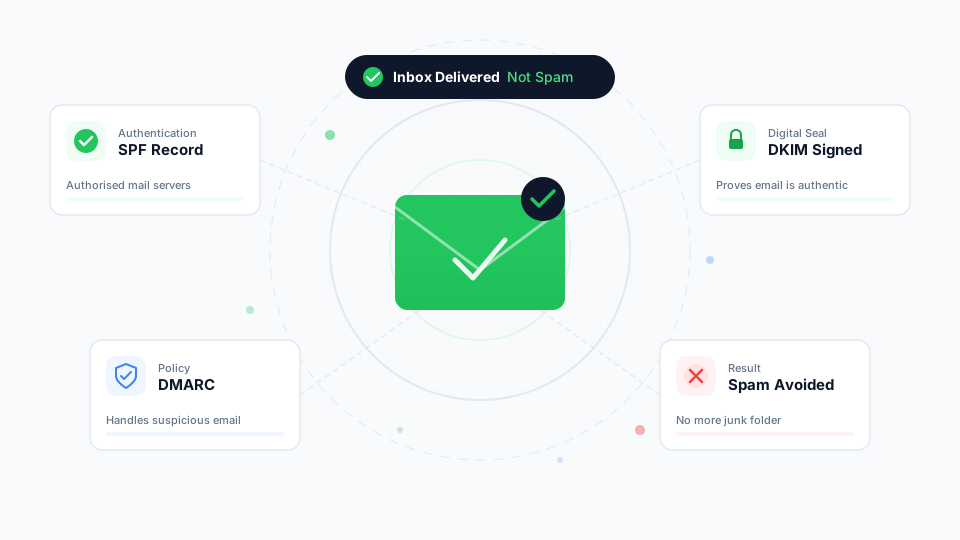
Since 2024, Gmail and Yahoo require bulk senders to authenticate their mail with records like SPF and DKIM. Proper email hosting makes setting these up straightforward, so your invoices and replies reach the inbox instead of the spam folder. If your current emails keep landing in junk, our guide on why business emails go to spam walks through the fix.
Data and compliance
Under Malaysia's Personal Data Protection Act (PDPA), businesses are responsible for how they handle customer information — much of which flows through email. Hosting your mail on infrastructure you control, ideally in a nearby data centre, keeps that correspondence under your management rather than scattered across personal free accounts.
Types of Email Hosting
This is the decision most guides skip. There are four common ways to get professional email, and the right one depends on your team size, budget, and how much collaboration you need.
1. Email included with web hosting (cPanel)
The default for most small businesses. Your hosting plan includes mailboxes managed through cPanel, accessible via webmail or any mail app. It costs nothing beyond your hosting, supports your own domain, and handles everything a typical business needs.
- Best for: Small and medium businesses, online stores, solopreneurs
- Strengths: No extra cost, unlimited or generous mailbox counts, simple management
- Trade-off: Fewer built-in collaboration tools than the Google or Microsoft suites
2. Standalone email hosting
A dedicated email service without web hosting attached. Useful if your website lives elsewhere (or you have no website yet) but you still want professional mail. Functionally similar to cPanel email, just sold separately.
- Best for: Businesses whose website is hosted elsewhere or who only need email
- Trade-off: You pay for email separately when bundled hosting would include it
3. Google Workspace
Gmail's business product: the familiar Gmail interface on your domain, plus Drive, Docs, Meet, and shared calendars. Powerful for collaboration, charged as a recurring per-user subscription.
- Best for: Teams that live in shared documents and need heavy collaboration
- Trade-off: Ongoing per-user fee that grows with headcount
4. Microsoft 365
Microsoft's equivalent: Outlook on your domain bundled with Word, Excel, Teams, and OneDrive. The natural fit for businesses already standardised on Office.
- Best for: Teams in the Microsoft ecosystem
- Trade-off: Same recurring per-user cost model as Workspace
How to Choose Email Hosting in Malaysia
Work through these questions before committing:
- How many mailboxes do you need? Count the role accounts (
sales@,support@,accounts@) plus one per staff member. Plans with unlimited accounts remove this as a worry entirely. - How much storage per mailbox? Businesses that send large attachments or keep years of correspondence need more headroom.
- Do you need real-time collaboration? If shared documents and video calls are core to how you work, weigh Workspace or Microsoft 365. If not, don't pay for what you won't use.
- Does it include deliverability tools? Look for built-in SPF and DKIM setup so your mail authenticates correctly from day one.
- Where are the servers? Mail handled in or near Malaysia — a Singapore data centre works well for local latency — keeps delivery fast and your data close.
- Is local support available? When email breaks, it's urgent. Round-the-clock support that understands Malaysian banking and government systems is worth a great deal.
- Will you also need a website? If yes, choosing web hosting that bundles email is almost always cheaper than buying the two separately.
How Email Hosting Works With Your Domain
You don't need to be technical to use email hosting, but a little context helps. Two things connect your domain to your mailboxes:
- MX records tell the internet which mail server is responsible for your domain's email. When your domain is hosted with the same provider, these are usually configured for you automatically.
- Authentication records (SPF, DKIM, DMARC) prove your mail is genuinely from you, which is what keeps it out of spam folders.
Once your mailbox exists, you can read it through webmail in any browser, or connect it to Outlook, Apple Mail, or your phone using IMAP. For the full setup — clients, forwarding, and deliverability testing — see our companion guide on setting up professional business email.
Getting Started
If you already run a website on cPanel hosting, you likely have email hosting included — log in and create your first mailbox today. If you're starting fresh, choosing hosting that bundles email is the most cost-effective route to a professional address.
Every Cynet business hosting plan includes unlimited email accounts, anti-spam filtering, and free SSL, all managed in cPanel from a Singapore data centre for low local latency. If you're still weighing options, our web hosting overview compares the plans side by side.
Wrapping Up
Email hosting is simply the service that runs your business email on your own domain — and for most Malaysian businesses, the smartest version of it is the one already bundled with web hosting. It costs little or nothing extra, makes your business look credible at every touchpoint, and — set up correctly — reliably lands in the inbox.
Start with one branded mailbox, point your customers to it, and add accounts as your team grows. It's one of the cheapest, highest-impact upgrades a small business can make to how it presents itself online.